

Swiftposium
Eras and aeons

Hey friends,
It’s been a while! More than on later maybe. But for now, a bit about my adventure at the Swiftposium, an academic conference on Taylor Swift.

I signed up for the conference for a few reasons. I’m not not a fan of Taylor Swift (I do like some of her music), but equally I’m probably not her main target audience. What I really love is a soapbox - a chance to speak to a lay audience, and hopefully catch them off guard. Show them that Classics and ancient history are more vibrant and versatile than they might expect.
I also thought it’d be a hell a lot of a fun, and it was. I heard some brilliant talks, met some great passionate people, and had my faith in the power of Humanities research renewed.
Anyway, here’s a polished up copy of the notes from my talk. Hope you enjoy.
“Don’t get sad, get even”: heartbreak and revenge eras in Herodotus
On the surface, a comparison between Taylor Swift and Herodotus seems… unlikely. If we came up with a Venn diagram of Swifties and Ancient Greek history stans, we’d have to zoom in quite a way to find the intersection.
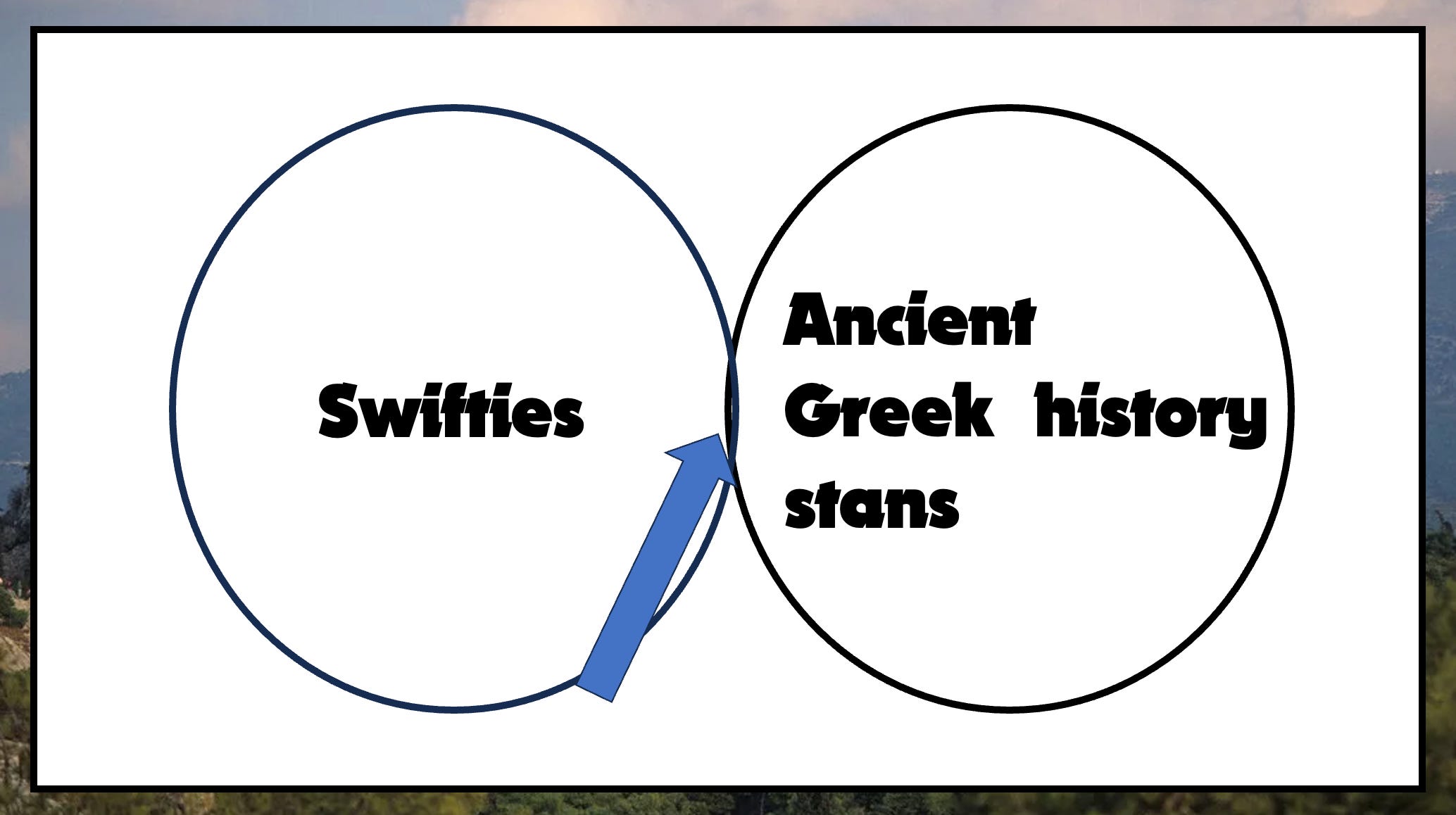
Not least because we’re talking about one of the most popular female artists of all time, and a discipline that has long been chauvinistic and male-dominated. Blokey tales of kings and warriors and generals. As an anecdote, Thucydides’ 8 book history of the Peloponnesian War makes just 6 mentions of women.
But Herodotus, the author my research is devoted to, is something of a positive exception, with a healthy 375 mentions. In his history of the wars fought between Greece and Persia, women are in the thick of the action. Primarily through stories that seem lifted right out of a Swift lyric. Ones of female revenge, the “bad blood” that results after a man wrongs a woman.
Herodotus gives these stories pride of place - in fact, he uses them as bookends, at the start of Book 1 and the very end of Book 9.
Let’s dive in…
Revenge era #1 - Candaules’ wife
At the start of Book 1, we hear the story of the Lydian king Candaules being assassinated by his wife.
Lydia is in many ways the forerunner to Persia - the imperial hegemon before the advent of the Persian empire.
One of their early kings, named Candaules, was said to have been so enamoured with his wife that he wanted his favourite bodyguard Gyges to see her naked. So Candaules makes a (very reluctant) Gyges hide behind the door in her bedroom to watch her while she gets changed. Inevitably, Candaules’ wife (never actually named) catches Gyges in the act, and is so appalled by her husband’s conduct that she blackmails Gyges into killing him:
“You must ambush him from the very same place where he made you leer at me, then attack him in his sleep.”
Gyges followed her into the bedroom… and she hid him behind that fateful door. Gyges leapt out and killed the king while he slept.
Revenge era #2 - Amestris, wife of Xerxes
Right at the end of the final book, after Xerxes’ invasion of Greece has been thwarted by Athens and Sparta at the battles of Thermopylae and Salamis, Herodotus tells us a salacious story about sexual intrigue in Xerxes’ court.
Xerxes’ wife is a very loyal and devoted woman named Amestris. Herodotus tells us that she weaved Xerxes a beautiful cloak which the king proudly wore around his palace.
Xerxes though is a considerably less loyal and devoted husband. He falls head over heels for the wife (never named) of his brother Masistes, and, as an excuse to spend more time with her, arranges for his son Darius to be married to their daughter Artyante.
Things get considerably messier when Xerxes also falls head over heels for Artanyte. Asking her what he can gift her to win her affection, Artaynte asks for the shawl Amestris made for him.

Aware of how humiliating this would be for his wife, Xerxes offers her whole cities and troves of gold instead. But Artaynte knows what she wants, and Xerxes reluctantly gives it to her.
Amestris is understandably furious, and picks her moment for revenge, waiting for the annual king’s birthday banquet, where it’s customary for the king to grant every gift requested of him. Amestris, suspecting that Masistes’ wife has put her young daughter up to it, asks for the woman to be gifted to her. Xerxes has no choice but to grant her request, and Amestris subjects her to terrible torture.
Wondering why
As we’ve seen, Herodotus gives these two revenge stories pride of place in his narrative, putting women like Amestris and Candaules’ wife in the thick of historical action. As the commentator Deborah Boedeker notes, this fact is often overlooked by Classics scholars:
“[This is] an aspect of Herodotean narrative that has received too little attention: how great a role relationships between men and women, and their mutual expectations about gender, play in determining events in the Histories…
“Time and time again, the interactions between an imperialistic male and a woman working independently, or even at cross-purposes with him, set the stage for major dynastic and military changes.”
The natural question is… why? With these stories of romance gone sour, bad blood, karma, female revenge - what is Herodotus getting at? What point is he trying to make?
Current scholarship has offered 2 main answers. As we’ll see, while these answers offer some important insights, they have limitations - they leave ‘blank space’ for further investigation.
Answer #1 - Herodotus wants to explore Persian gender paradigms.
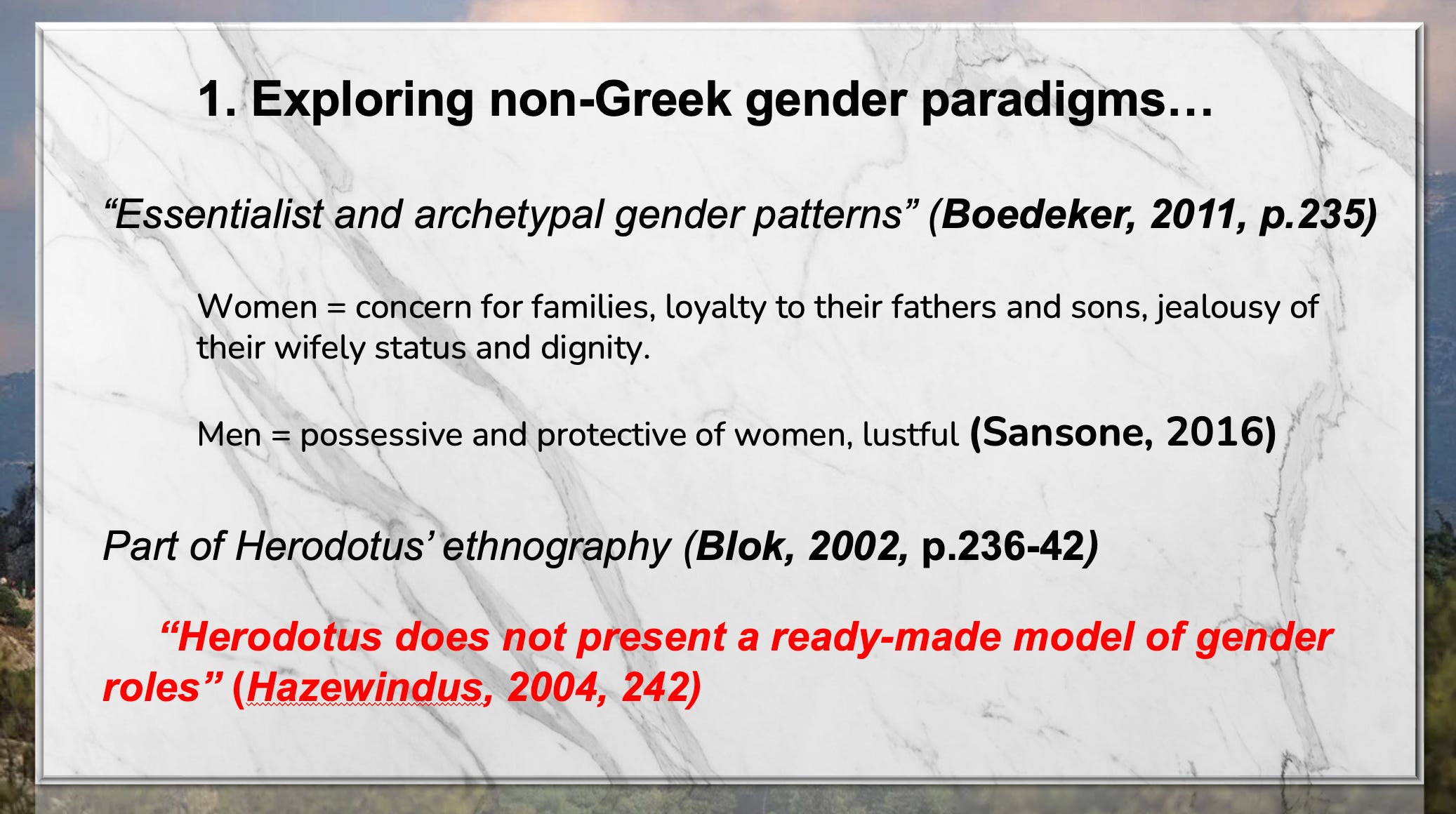
As Boedeker puts it, Herodotus is interested in studying the “essentialist and archetypal gender patterns” that exist in Persian (or other non-Greek) royal courts. Persian men and women have fundamentally different desires and drivers, and conflict arises when these desires clash. Specifically, Persian women are predominantly interested in protecting the status and integrity of their family unit, whereas men are often driven by lust and greed.
Why is Herodotus interested in interrogating these Persian gender dynamics? According to Josine Blok, it’s part of his ‘ethnography’ - his attempt to understand the cultural and ethnic differences of the non-Greek people who are involved in the Persian Wars.
This idea is disputed by scholars like Caroline Dewald and Minke Hazewindus. They argue that Herodotus doesn’t actually offer a consistent picture of gender roles and archetypes - each woman is different in her own way. They also argue that women in the Persian court are actually presented in typically Greek ways - they seem to adopt the Greek conception of monogamous marriage, rather than the Persian custom of polygamous, concubine harems.
Answer #2 - Herodotus is making links to Greek tragedy and myth
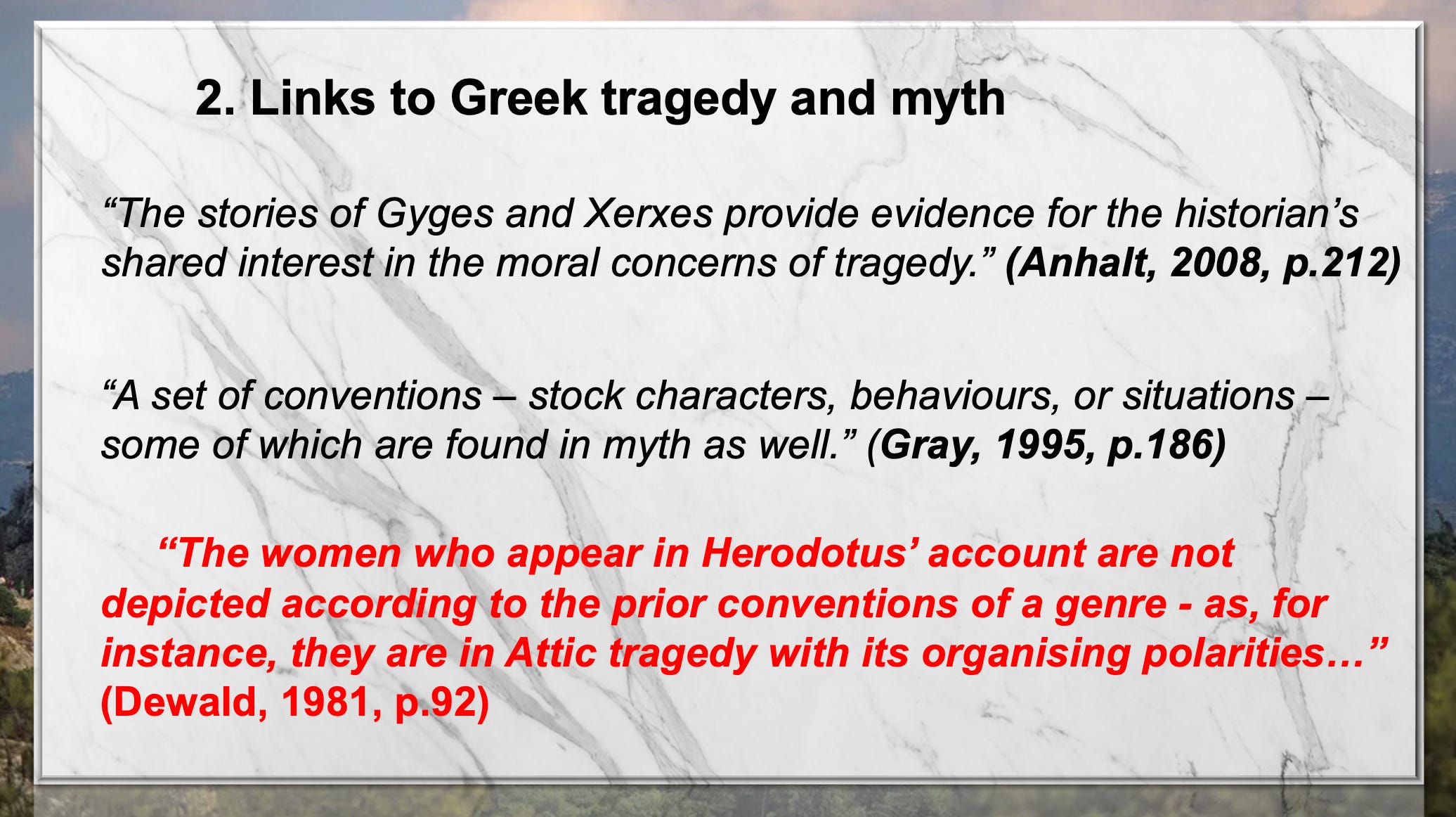
The argument here is that the theme of female revenge is a common trope in Greek tragedy - think of plays like the Medea and Agamemnon, where Medea and Clytemnestra enact punishment on their husbands for marital transgressions.
More broadly, the idea of marital strife as a cause of war is common in Greek myth and epic - think of the Iliad, where the Trojan War is launched because Menelaus wants to punish Paris for stealing Helen, and the great warrior Achilles refuses to fight because his beloved concubine Briseis has been stolen by Agamemnon.
So it’s argued that Herodotus wants to apply this dimension of tragedy and myth to his own writing - we know, for instance, that he was a contemporary and acquaintance of the Greek tragedian Sophocles, and that his text features numerous intertextual allusions to Homeric epic.
Once again, though, this idea isn’t uncontroversial. And the main rebuttal is, again, that Herodotus’ women are more well-rounded than just literary stocks and tropes, or ethnographical gender case studies. Caroline Dewald has this idea that Herodotus, fundamentally, presents women “as they are” - each one is different, and presented in a unique, plausible, coherent way.
My Answer #3 - Herodotus is exploring the depths and breadth of human motivation
I am attracted to Dewald’s idea that Herodotus presents women “as they are”, and that there is something humanistic about his portrayal of women.
Certainly these stories must be of ethnographic interest to Herodotus, and certainly they resonate with Greek myth and tragedy. But I suggest that Herodotus is also curious about the human condition - about the human experience of rejection, humiliation and betrayal.
This is part of one of the core campaigns of his project, to understand the depths and breadth of human motivation. As he says in his very first chapter, his central question is “what caused the Greeks and Persians to war with one another?”
Part of the answer is fate and the will of Gods - particularly the idea of divine jealousy, the gods intervening to humble individuals or even whole empires that get too big for their boots.
But equally, a big part of the answer is human psychology. Human decisions caused the war! Emotions!
As Emily Baragwanath notes in her book ‘Motivation and Narrative in Herodotus’, Herodotus is very interested in this internal battle between our better and worse natures. Between kleos, the Greek word for honour, renown, or noble principle. And kerdos, the Greek word for profit, personal gain, selfishness.
And so throughout his work, Herodotus paints this tableau of different emotional experiences - the kinds of feelings that make historical figures take bold decisions, whether for kleos or kerdos or a mixture of both.
These stories of women acting out of jealousy and spite must be understood not as isolated stories or anecdotes, but as part of this tableau - this overall attempt to explain human reasoning, motivation and decision-making.
What are the most powerful human experiences, the ones that send us down the path of war, that make us choose violence, conflict, blood, glory, revenge?
Herodotus will seize upon any story that helps him (and us) find out.
The overlap
As part of this campaign to understand human motivation, it’s fascinating to note that Herodotus ends up identifying a part of the human experience that is still incredibly culturally relevant today.
Break-ups, heartbreaks, betrayals - Herodotus sees that these experiences, these wounds can become core to our sense of self. They can start to dominate our thinking. They can fill us with rage and vengeance.
I think of this viral video of a fan at an Eras concert FaceTiming her ex to sing ‘We Are Never Ever Ever Getting Back Together’.
Look at the emotional release, the feeling of giving your ex one big fuck you, all the vindication and catharsis.
This is the feeling that Herodotus is pinpointing as a driving force in history. As something that can quite literally bring about new eras!
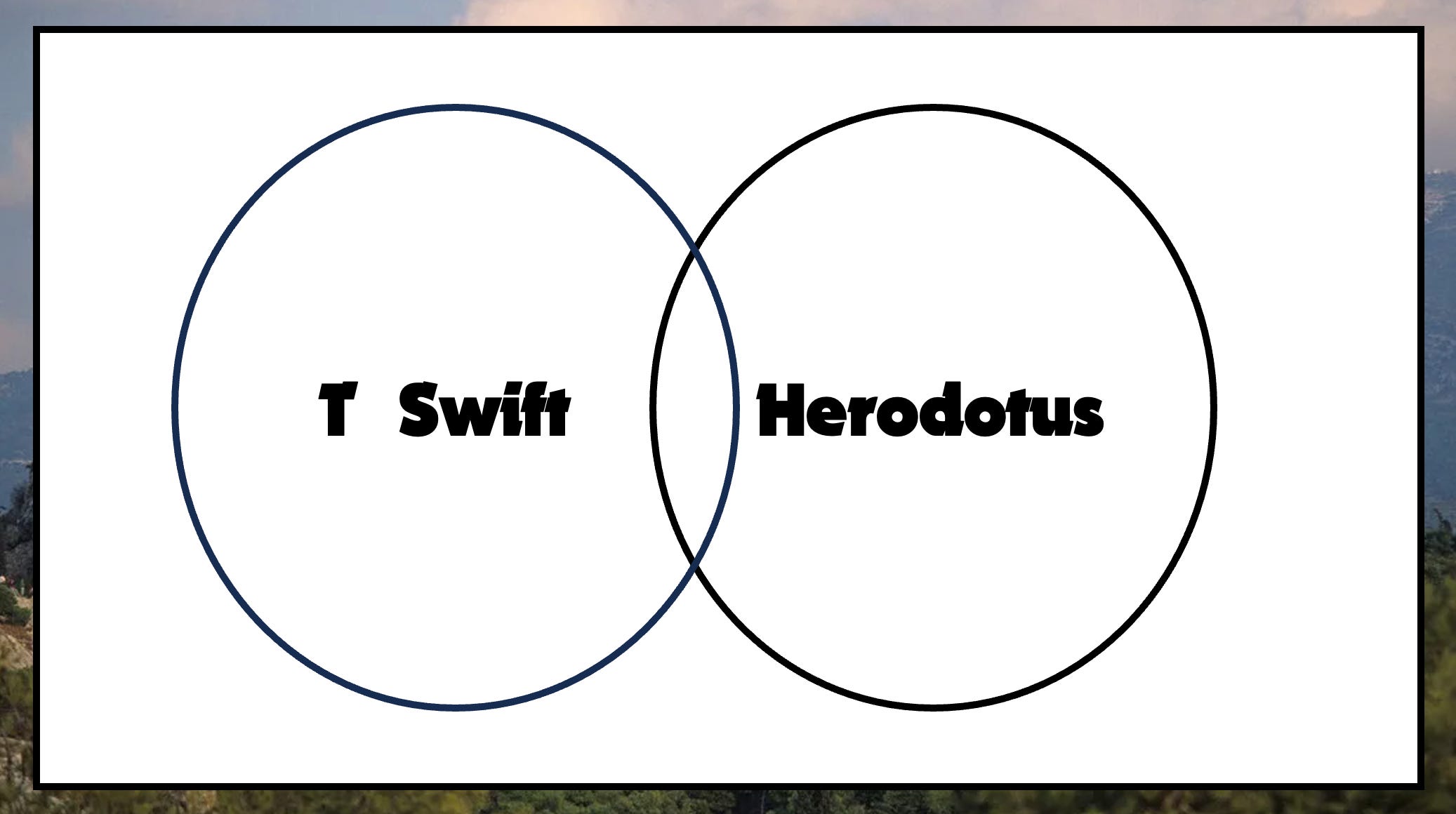
So to return to our Venn diagram, perhaps there’s more overlap than we might have thought.
The differences
Still though, there are naturally plenty of differences. So to finish, a few comments on how the idea of revenge in modern break up songs differs from revenge in the ancient Greek tradition.
In the context of Herodotus and broader Greek culture, revenge can only be expressed by actually carrying out a vengeful act - it must be sealed in an actual attention-grabbing act of violence. This is because women (even aristocratic ones) had such limited autonomy and agency, that the only way they could make make powerful men like Candaules and Xerxes take notice was through shocking, norm-breaking acts of violence and cruelty.
In the context of modern culture and modern pop music, this is (hopefully) not the case. Revenge is about a feeling - using feelings of vengefulness as inspiration to work on yourself. Actively punishing your ex isn’t necessarily the end goal - but rather to use those vindictive, vengeful thoughts as the fire you need to get out of bed, stop moping, and prove that you don’t actually need them in your life. You shake it all off. You go and find someone who will treat you better. And you make that schmuck of an ex watch you become bigger and bolder and better off without them.
This sort of path was hardly available to women back in ancient Greece and Persia. The wife of a Persian king couldn’t ‘move on’ in a sassy or satisfying or self-actualising way - this is a thoroughly modern idea that would have been very foreign in the Persian court, just as the idea of using violence or murder to punish someone who has shamed you is a very abhorrent idea to us, but was more prominent in the minds of the Greeks.
The ancient moderns, the modern ancients
But the root feelings are still the same!
That raw, guttural feeling of being betrayed, or rejected, or humiliated. The fiery anger when you hand over your heart to someone, and they choose to smash it into pieces. This much at least hasn’t changed across thousands of years.
I think the more you study history, the more you notice that even though ways of expression change, the root feelings stay the same. Social norms and gender paradigms shift. The cultural context that surrounds our relationships can become radically different. But we’re still talking about the same human heart. With the same capacity to beat, and to break, and to boil.
So you can look at any period of history, however remote, and still find people going through similar experiences to you. And you can find bold, ambitious voices trying to come to terms with those experiences, trying to capture and make sense of them for a wider audience.
Hopefully what my talk today has illustrated is the timelessness of the kinds of feelings that make Taylor Swift’s break-up songs so enormously popular. But also, the vitality and vibrance of ancientt exts like Herodotus’ Histories.
I think in many ways, that’s the goal of Classics and Ancient History - realising how thoroughly ancient we are, and how thoroughly modern the ancients were.
As the great historical novelist Hilary Mantel once said, “the dead have a vital force still - they have something to tell us, something we need to understand.” I hope, through this rather ambitious comparison between Taylor Swift and Herodotus, you’ve felt something of that vital force.
Cheers.
Fantastic piece, just one little question. Is it Artyante, Artanyte, or Artaynte???